
China Top 10 Clamp On Water Flow Meter Manufacturers?
Choosing the right Clamp On Water Flow Meter can affect billing accuracy, process control, and maintenance costs. China has become a major source of ultrasonic flow measurement equipment. Its manufacturers serve water treatment plants, HVAC systems, irrigation networks, and industrial pipelines.
This guide introduces ten leading Chinese manufacturers and explains how they differ. We consider product experience, measurement technology, certification practices, and after-sales support. Practical details matter. A reliable supplier should explain pipe diameter limits, fluid temperature, liner material, and expected accuracy. Installation guidance also matters, especially when sensors must attach to an old steel pipe without shutdowns.
Look beyond catalogue claims.
The review also considers signal output, battery life, data logging, and communication options such as RS485 or Modbus. These features can determine whether a meter integrates smoothly with an existing control system. Factory testing, calibration records, and application-specific references provide stronger evidence than attractive product images.
No ranking is perfect. Manufacturer capabilities may change, and a strong product for clean water may perform differently with wastewater, bubbles, or heavy pipe scaling. Buyers should verify current specifications before placing an order. This article therefore offers a practical comparison, not a substitute for site testing or engineering review. It aims to help distributors, contractors, and end users ask better questions and avoid costly mismatches. Reliability begins with accurate requirements.
What Is a Clamp-On Water Flow Meter?
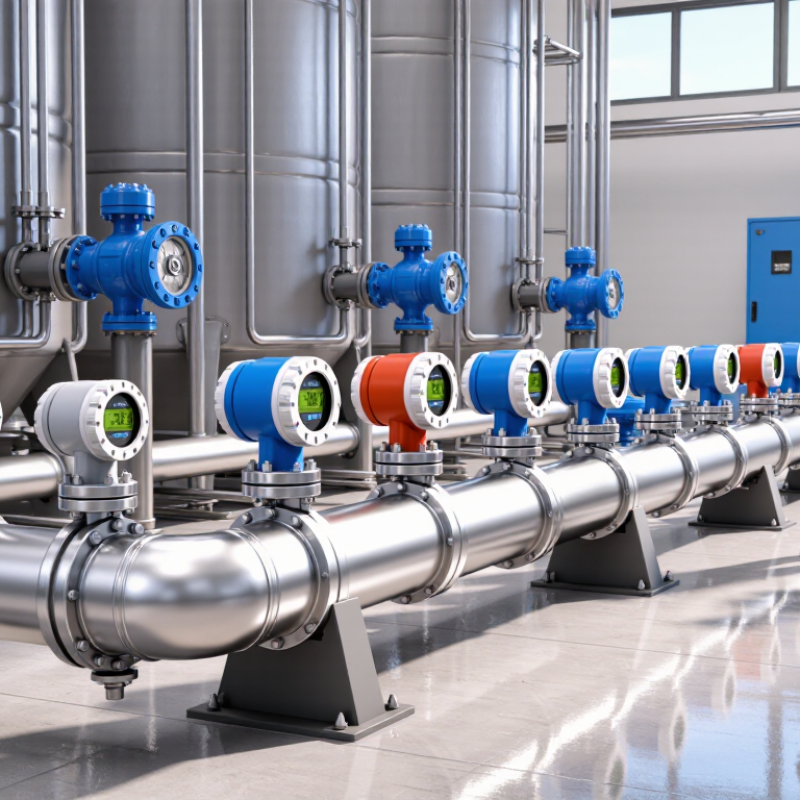
A clamp-on water flow meter measures water without cutting the pipe. It uses sensors fixed to the outside wall, usually with straps and coupling gel. Ultrasonic signals travel through the pipe and compare upstream and downstream transit times. The difference reveals flow velocity, direction, and approximate volume.
Installation is fast. A technician can test chilled water, process lines, or temporary bypass pipes while the system remains operating. The MarketsandMarkets 2024 report valued the global flow meter market at about USD 8.3 billion and projects it to reach USD 11.1 billion by 2029. This growth reflects stronger demand for measurable water efficiency. The U.S. Environmental Protection Agency also reports that household leaks can waste nearly 10,000 gallons annually. Small errors become expensive.
Accuracy depends on reality, not only specifications. The pipe needs a suitable straight run, stable contact, and correct pipe data. Rust, heavy scale, air bubbles, or partially filled pipes can distort readings. Doppler models need suspended particles, while transit-time models usually perform better with cleaner water. It is not magic. A reading may look precise but still deserve checking against a reference meter. In field work, I would record pipe material, temperature, sensor spacing, and flow conditions before accepting the result. That extra record feels slow, yet it often exposes installation mistakes.
China Top 10 Clamp On Water Flow Meter Manufacturers? - What Is a Clamp-On Water Flow Meter?
A clamp-on water flow meter is a non-invasive ultrasonic instrument installed on the outside of a pipe. It measures flow by transmitting ultrasonic signals between sensors and calculating the difference in transit time caused by moving water. The following table provides a practical, brand-neutral reference for evaluating clamp-on water flow meter suppliers and selecting suitable specifications.
| No. | Typical Application | Common Pipe Material | Typical Pipe Size | Typical Accuracy | Recommended Flow Velocity | Typical Liquid Temperature | Installation Method | Common Outputs | Main Advantage |
|---|---|---|---|---|---|---|---|---|---|
| 1 | Municipal water distribution | Ductile iron, cast iron, steel, PVC | DN50–DN2000 | Typically ±1.0% to ±2.0% of reading | 0.3–12 m/s | 0–60°C | External clamp-on sensors | 4–20 mA, pulse, RS485 | No pipe cutting or service interruption |
| 2 | Water treatment plants | Carbon steel, stainless steel, lined pipe | DN25–DN1200 | Typically ±1.0% of reading | 0.1–10 m/s | 0–80°C | V-method or Z-method mounting | 4–20 mA, relay, Modbus RTU | Suitable for clean or lightly treated water |
| 3 | Industrial process water | Steel, stainless steel, alloy pipe | DN50–DN1600 | Typically ±1.0% to ±1.5% of reading | 0.2–15 m/s | -20–120°C | Clamp-on or fixed external sensors | 4–20 mA, pulse, Ethernet or RS485 | Measurement without contact with the liquid |
| 4 | Cooling-water systems | Steel, copper, plastic-lined pipe | DN40–DN1000 | Typically ±1.0% to ±2.0% of reading | 0.3–8 m/s | 5–45°C | External sensors with removable coupling | 4–20 mA, pulse, alarm relay | Fast installation during maintenance |
| 5 | HVAC chilled-water circuits | Carbon steel, stainless steel, copper | DN25–DN800 | Typically ±1.5% to ±2.0% of reading | 0.1–6 m/s | 0–50°C | Clamp-on sensors with thermal insulation | 4–20 mA, BACnet or RS485 | Minimal pressure loss and easy retrofitting |
| 6 | Building water consumption monitoring | Steel, copper, PVC, PPR | DN20–DN300 | Typically ±1.5% to ±3.0% of reading | 0.1–5 m/s | 0–50°C | Compact clamp-on installation | Pulse, M-Bus, RS485 or wireless gateway | Useful for retrofit submetering |
| 7 | Irrigation and agricultural water | PVC, HDPE, ductile iron, steel | DN50–DN1200 | Typically ±1.5% to ±2.5% of reading | 0.3–10 m/s | 0–60°C | Portable or fixed clamp-on sensors | Battery display, pulse, RS485 | Portable measurement across multiple pipelines |
| 8 | Raw-water intake systems | Concrete-lined steel, cast iron, ductile iron | DN200–DN3000 | Typically ±1.0% to ±2.0% of reading | 0.3–12 m/s | 0–60°C | Wide-spaced Z-method sensors | 4–20 mA, pulse, data logging | Large-diameter measurement without welding |
| 9 | Leak detection and night-flow surveys | Metallic and plastic pipes | DN25–DN600 | Typically ±1.5% to ±3.0% of reading | 0.05–5 m/s | 0–60°C | Portable clamp-on sensors | Internal memory, USB, Bluetooth or RS485 | Non-invasive temporary field surveys |
| 10 | Remote water network monitoring | Steel, iron, PVC, HDPE | DN50–DN2000 | Typically ±1.0% to ±2.0% of reading | 0.1–12 m/s | -20–80°C | Fixed external sensors with remote enclosure | 4–20 mA, Modbus, cellular or IoT gateway | Enables centralized data collection |
Technical note: The values shown are common industry ranges rather than universal specifications. Actual performance depends on pipe material, internal lining, liquid quality, sensor spacing, straight-pipe length, flow profile, temperature, and calibration. Always confirm the final accuracy, measuring range, communication protocol, and environmental rating in the supplier’s datasheet.
Related Posts
-
China Top 10 Clamp On Water Flow Meter Manufacturers?
-

Ultimate Guide to Choosing the Best Clamp On Water Flow Meter for Your Needs
-
Driving Innovation in Water Management Solutions at the 138th Canton Fair 2025 with Clamp On Water Flow Meters
-
What is a Digital Water Flow Meter and How It Improves Water Management Efficiency
-
Top Water Flow Meter Types for Global Buyers?
-
What Is the Best Water Flow Meter from China?